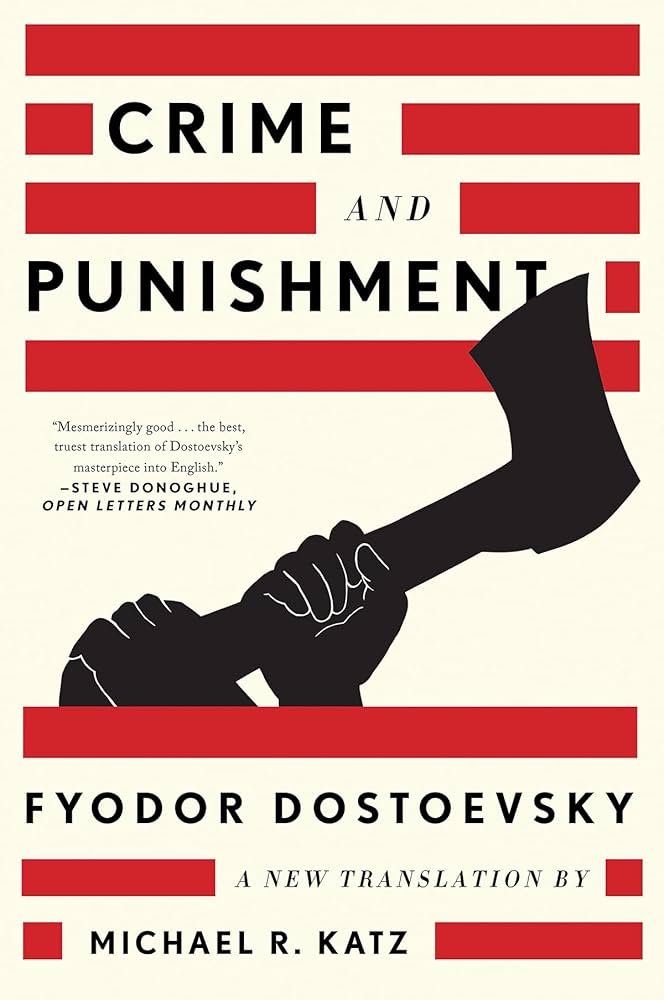
Favourite quotation
“It is necessary that every man have at least somewhere to go. For there are times when one absolutely must go at least somewhere!”
Fyodor Dostoevsky (2012). “Crime and Punishment”, p.14, Vintage
Personal review
If indeed you are reading this review of a book so well established as a paragon of literature, perhaps one of the greatest set of sentences put together in the English language, written by an author whose fluency with human nature is so profound that several modern psychologists routinely cite his work despite it not even being an academic piece then it is possible that you know me personally in some limited capacity in order to even consider seeking my opinion. For even if I was to shun you away from reading this masterpiece you must think me mad at that specific moment and devoid of my rational faculties. The recommendation itself would sound so incongruent that you would question my state of mind before questioning the book.
So what I will instead do is explain, although rather briefly, how this book is useful to those uninterested in fiction in the first place. That is, what can it teach me. I am not here to praise the beauty of the prose or the cleverness of the plot for its own sake. I am here to show the practical value it holds for a mind that usually prefers nonfiction, history, or straight analysis over invented stories.
The only problem with this is that I cannot demonstrate this without revealing the entirety of the novel, so you will have to place your trust in me to an extent that I am right. I will try to keep the spoilers light, but the usefulness of the book lives inside the full arc of what happens to the main character. Without that arc the lessons stay abstract. Trust that I am not exaggerating the effect.
First of all the book is very useful at giving words to the one in an emotionally turbulent state, a framework in which to place his mind. Most remarkably he does not go through the famed five stages of grief (denial, anger, bargaining, depression and acceptance). Instead he gets stuck on denial and the novel develops in an interesting angle from this. The mind keeps insisting that the act was necessary or justified or somehow outside ordinary moral rules, and the story follows that insistence all the way down. More specifically Dostoevsky illustrates the consequences of this path so convincingly that you too begin to fear taking it. You watch the slow corrosion of ordinary thinking, the isolation that grows even in crowded rooms, and the way every small interaction becomes charged with hidden meaning. You will find empathy in his characters and may place them as avatars of your emotions. Then critique and work your way around them strategically if you wish to do so. The novel hands you a clear map of one dangerous mental route so that you can recognise the early signs in yourself and choose a different direction before the road becomes too steep.
The second fact is that Raskolnikov lives a normal life. Dare I say a sometimes boring one (or perhaps I am too dense to grasp hidden meaning at times). He walks the streets, talks to people, frets over ordinary money troubles, and goes through days that feel almost mundane between the heavier moments. Dostoevsky clearly illustrates how doing something that troubles your conscience seems to “fight back” against the suppression. His guilt does not sit quietly as we might expect it to; it surfaces in sudden irritability, restless pacing, and those odd moments where Raskolnikov’s thoughts twist in on themselves without warning. Dostoevsky also demonstrates what happens when you don’t confide your secrets, or at least “offload” your conscience to some extent. The longer it stays locked inside, the more it warps every conversation and every decision, turning even simple interactions into small battles. And he illustrates how your state of mind can vacillate between desolate collapse and righteous elevation, swinging from crushing despair one hour to a strange, almost proud clarity the next, as if the mind itself cannot settle on a single story about what it has done.
The third thing is that this author is not some Nietzsche who drops anvils of philosophically dense arguments on the reader and smash their poor contrite spirits before they even begin to recuperate. There is no cold lecture delivered from on high. I believe Dostoevsky takes you by the hand and leads you down the path of “hard knocks” and bids you adieu on a positive note. He lets you walk alongside the suffering, feel the weight of it, and still arrive somewhere that feels like a quiet release rather than pure wreckage. You have experienced and deduced wisdom that otherwise would require a destructive event to ensnare your well-being to gain. The lessons about guilt, isolation, and the need for some form of confession settle in without demanding that you first destroy yourself to learn them. Very few authors can convincingly do this and just this experience alone makes him worth reading.
Crime and Punishment is really just about the Punishment. It walks you through the slow, grinding aftermath and leaves you with a clearer sense of how a troubled conscience works its way through ordinary days until its too much to bear for ones psyche. Though this is not always the case, the ending is satisfying and deserved, which makes the journey worthwhile if that is your primary concern.
★★★★★
Arduous, but Splendid