Personal Review
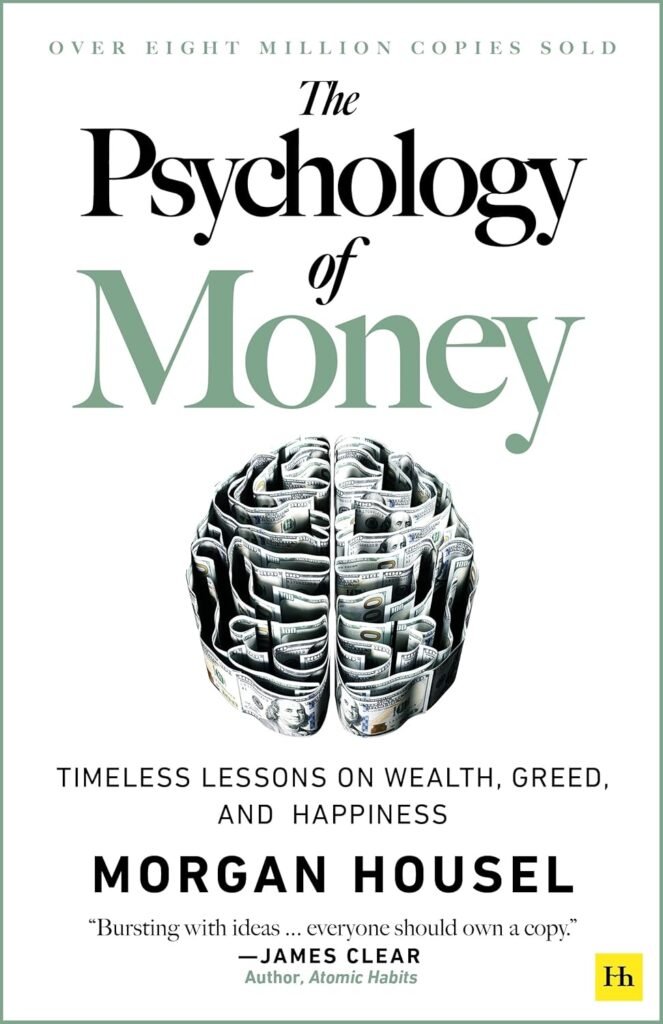
Morgan Housel has explained a philosophy of how you may think about money beyond its primary functions. Take any economics class, and you will eventually learn that the functions of money are a medium of exchange, a unit of account, a store of value, and a standard for deferred payment. As it can be used to appraise the value of a good, any subsequent large amount of money holds with it the aggregate of pleasure derived from all the experiences and articles we may receive in exchange for trading it. Money is then equated with pleasure, and we are motivated to pursue an accumulation of it. Because it is also a store of value, it acts as a form of security, motivating saving and insurance. Its ability to allow us to experience things without immediate loss through credit mechanisms gives us a false feeling of invincibility. Individually, these functions of money impose behavioral forces that conspire with our internal desire, as Jeremy Bentham once described, to maximize utility and minimize pain.
The psychology of money rejects this philosophy as both backward and destructive to the financial health of the individual. Housel takes the approach through his 20 principles that our rational experience of money is not divisible from our emotions, and that the individual is irrevocably biased against himself. Housel pleads that we understand and accept this not as a fault, but as a feature of how we interact with the cash in our hands.
For example, in Chapter 14, he presents the secret to Warren Buffett’s wealth as being inaction. Patience and indifference to the oscillating ramblings of the market are rare, and those who cannot practice them are controlled by their emotions. In Chapter 7, he demonstrates how freedom is the most important thing money can purchase. The next chapter, about the man in the car, dissects the mechanism of what we believe money does for us versus its actual impact on our societal perception. He demonstrates the benefits of the inverse of that idea. When reaching investment strategies, he demonstrates how mathematically proven strategies often clash with our emotions when the music starts to go dark in front of our eyes.
In 2008 a pair of researchers from Yale published a study arguing young savers should supercharge retirement accounts using two-to-one margin (two dollars of debt for every dollar of their own money) when buying stocks. It suggests investors taper that leverage as they age, which lets a saver take more risk when they’re young and can handle a magnified market rollercoaster, and less when they’re older…The math works on paper. It’s a rational strategy. But it’s almost absurdly unreasonable. No normal person could watch 100% of their retirement account evaporate and be so unphased that they carry on with the strategy undeterred. They’d quit, look for a different option, and perhaps sue their financial advisor.
Page 117
While some insights seem obvious, Chapter 14, “You’ll Change,” is perhaps my favorite. We assume that our preferences and priorities remain constant in the long run. We may intuitively agree with this, but only from a third-person perspective could someone truly understand its implications. This principle more clearly demonstrates what Housel has taken the liberty to do for all of us: consider our financial decisions from the third person. I call this the movie star analogy: if you were watching a movie where you were the protagonist, what would you have him do, and how would you deem him to behave? The Psychology of Money invites us to think this way about our finances.
That being said, it does not have a comprehensive answer to everything. Many times in the book, I felt that Housel’s principles were best suited to the citizens of more prosperous countries, where welfare states or high incomes compensate at the bottom line for several deficiencies that most of the world suffers with. For in several nations, just to live the life of an average American citizens one must reside in the top 10% of income earners. So when Housel talks about how pursuing “luxuries” does not make a man happy, he does not realize that that the term comes to mean different things depending on where you read it. However, this limitation does not diminish the value of the broader message. Ultimately, The Psychology of Money succeeds because it shifts the focus from complex financial modeling to the human behavior behind our choices. Housel reminds us that doing well with money has little to do with how smart you are and everything to do with how you behave. By encouraging humility, adaptability, and an awareness of our own emotional blind spots, the book offers a refreshing, grounded roadmap for navigating an inherently unpredictable financial world.
★★★★★
Part of the core syllabus to financial success