Favorite quotation
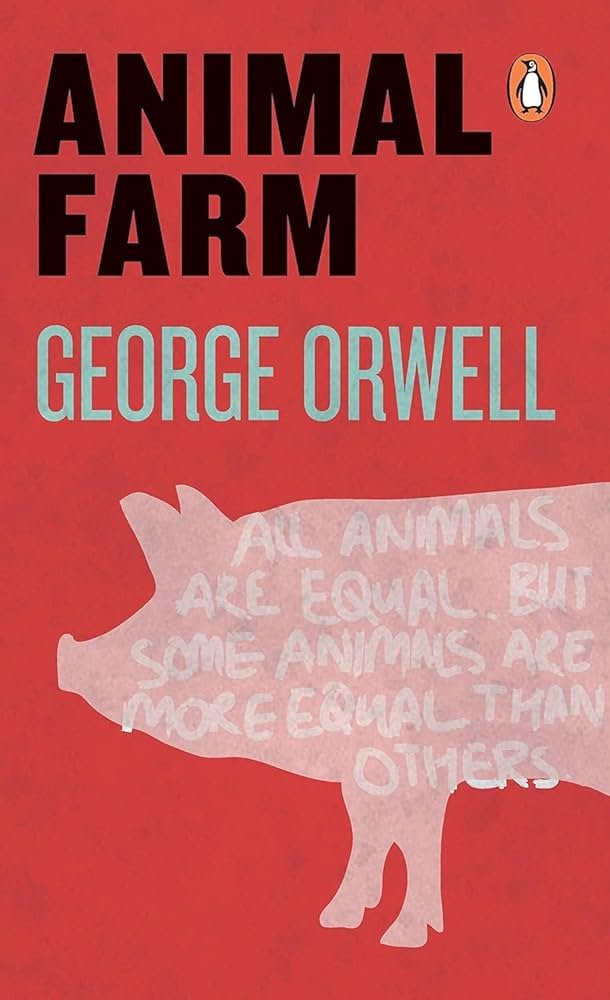
“Twelve voices were shouting in anger, and they were all alike. No question, now, what had happened to the faces of the pigs. The creatures outside looked from pig to man, and from man to pig, and from pig to man again; but already it was impossible to say which was which.”
– The final paragraph of Animal Farm
Personal Review
Being an incredibly short and simple novel, I read this maybe four years ago. It was not until I had been formally mandated to examine the history of the Russian Revolution that I began to recognise apparent similarities between the narrative of Orwell’s dystopian novella and what the Communists set out to do, and ended up doing, to their wonderful country.
I think it was the memorability of the Stakhanovite movement, a state-propelled legend of Alexei Stakhanov, a coal miner who produced roughly 14 times his required quota, around 102 tons of coal in a single six-hour shift on August 31, 1935, that first caught my attention. Workers were encouraged to be Stakhanovites and work beyond their quotas in order to propel the Union towards industrial brilliance. All of which rhymed melodically with poor old Boxer’s motto, “I must work harder”, his answer to every problem presented to him, causing me to look at the book again and draw new revelations from it.
Indeed, it was as if I had been blinded by an epistemic fog, for I joyously drew endless parallels until I reached the trite observation that this was ultimately another critique of the communist system, one that was rather shorn of the good practice of nuance and doubt much more present in more academic critiques.
It was not that I held any overtly liberal reservations or sentiments towards those who had taken their shot at realising the Marxian ideal, nor towards those who will continue attempt to do so for the foreseeable duration of my stay on earth. But I do believe that knowing the intentions behind Animal Farm beforehand irrevocably reframes its interpretation for the reader. I had the rare opportunity of reading it with a pure heart, free of any political allegiance, and still found the evil that the more opinionated reader will likely automatically assume exists.
Perhaps, if Orwell had done a better job of disguising the subject of his analysis, and had not structured his narrative such that the reader could come to a conclusion on his own, the work would be elevated from an expression of political distaste to a legitimate case for the moral squalor present in the Russian expression of the communist political system. But this only concerns the modern readers who take up the piece today and wish to derive instruction from it.
Orwell certainly had guts writing in 1944, facing rejection from many publishers due to the British being allies of the Soviets during the Second World War. He was right, but still politically wrong. In any case, the book exploded in popularity once the Cold War began, and during the early phase of McCarthyism, which was basically a few years when everyone even slightly to the left of the political compass was liable to be labelled a communist or Soviet agent. The hyper-paranoia against the Soviets that had now become the “bad guys” needed explanation as Stalin began solidifying the Cold War by blocking Berlin and “liberating” much of Eastern Europe with socialist dressing. Therefore as it was written before Animal Farm became a convenient testament of a man who recognised the evil and was now proven right about it.
It was a prediction of what had now become a fashionable truth. In fact, the CIA went as far as to acquire the film rights to the book and weaponise it as propaganda, surgically editing out Orwell’s transmuted critique of capitalism through the transplantation of a few Marxist justifications and the amplification of the evils of the tyrants. Yes, all that is in the book as well. You just need to look for it.
But why am I telling you all this? Because this is not “A Fairy Story”, as Orwell himself subtitled it. It is a knife , a weapon of words that will stab and twist your heart, such that you will cry out at the injustice done to those poor animals, which in your mind are functionally the victims of communist tyranny. I wish I could say that Orwell exaggerated on this, but my own research, and that of many prominent historians as well would suggest, that he might in fact have been a bit generous when it came to the way the Soviets treated their citizens. Regardless, read with foreknowledge of all these things.
Animal Farm is an excellent book because it makes you feel for poor animals that we would not hesitate to eat in a moment. It also uncomfortably thrusts us towards the truth of how dissimilarly we treat our fellow humans, and how we ourselves can behave no differently from animals, when we discarding our moral faculties and yielding to the greed of power and ambition. It is a call for self-reflection and disillusionment, meant for those who propose a dilution of the individual and the exaltation of the state.
★★★★★
Heart wrenching, but convincing anti-communist propaganda